When we first get behind the wheel, we expect everything to go as planned, for us to get to our destination on time with no mishaps. Unfortunately, this is not always the case. While pilots must demonstrate expertise in responding to emergency situations, the typical automobile driver undergoes no such training; oftentimes, the first time they are forced to respond are during life-threatening situations. Here are 5 driving emergencies that relate to tire/acceleration errors and how to respond to them safely and efficiently.
1) Tire Blowout
When people first hear the pop of a tire blowout, most people tend to instinctively slam on the breaks and get off the road, which is actually likely to result in a crash. Instead, you should lightly press on the gas pedal to gain control of the car and keep driving straight down the lane, allowing your car to coast until it reaches slow speed (about 30MPH). Only then should you gently turn towards the shoulder of the road that is on the same side as the blown tire. To prevent blowouts in the first place, be sure to check your tire pressures routinely.
2) Tread separation
The technique is similar to that of a blowout, but this situation is more dangerous because it can become audibly undetectable after the tread falls off, and because the steel-backed rubber is spinning at high speeds that can easily destroy and injure. If you experience a tread separation, lightly press on the gas pdeal, drive straight down the lane, allow the car to coast to a slow speed until you can turn to the shoulder of the road.
3) Stuck Throttle
If your engine is running uncontrollably, you should stop it immediately. Often this happens while pushing the brake, so you should release and put the transmission in neutral (or at least switch off the ignition).
4) Sudden Acceleration
This is similar to a stuck throttle except the problem lies not with mechanical failure, but with the driver accidentally stepping on the gas instead of the brakes. The correct response is the same as with a stuck throttle, so please see #3 above.

Where we regularly post helpful articles on anything automotive. Basic how-to guides, as well as relevant information on buying and maintaining a car in Northern California.
We also share what's going on at Hanlees, like news, staff highlights, and more!
Showing posts with label hanlees helpful tips. Show all posts
Showing posts with label hanlees helpful tips. Show all posts
Thursday, June 26, 2014
Monday, June 2, 2014
Top 4 Reasons You Get Pulled Over
We've all been in a situation where we're in a hurry to get to our final destination when, lo and behold, we see flashing lights behind us and get pulled over. It's easier to get pulled over than you think — keep these below five violations in mind the next time you hit the road.
- Speeding. This is dangerous for obvious reasons: the faster you go, the longer your reaction time to an unexpected situation, such as an upcoming pedestrian or sudden lane change from another car. Braking distances increase as well, increasing your chances of bumping into the car ahead of you without proper awareness.
- Distracting driving. The use of cell phones while driving was banned in several states due to the dangers of distracted driving, with the restrictions ranging from only texting to all use. Drive as though your life depended on it, because even that one second you take to send a text can mean the difference between life and death.
- Hazardous driving. The two most common are following too closely (slowing reaction time) and improper lane changes (cutting someone off, changing lanes without looking first, or failing to signal). This also includes stop sign and stoplight violations, improper lane changes, illegal U-turns, failures to yield, and unsafe speeds.
- Equipment violations. These include heavily tinted windows, burned-out headlights, broken windshields, expired tags, the lack of a front license plate (in California and some other states) and loud exhaust modifications.

Thursday, February 27, 2014
Traffic jams
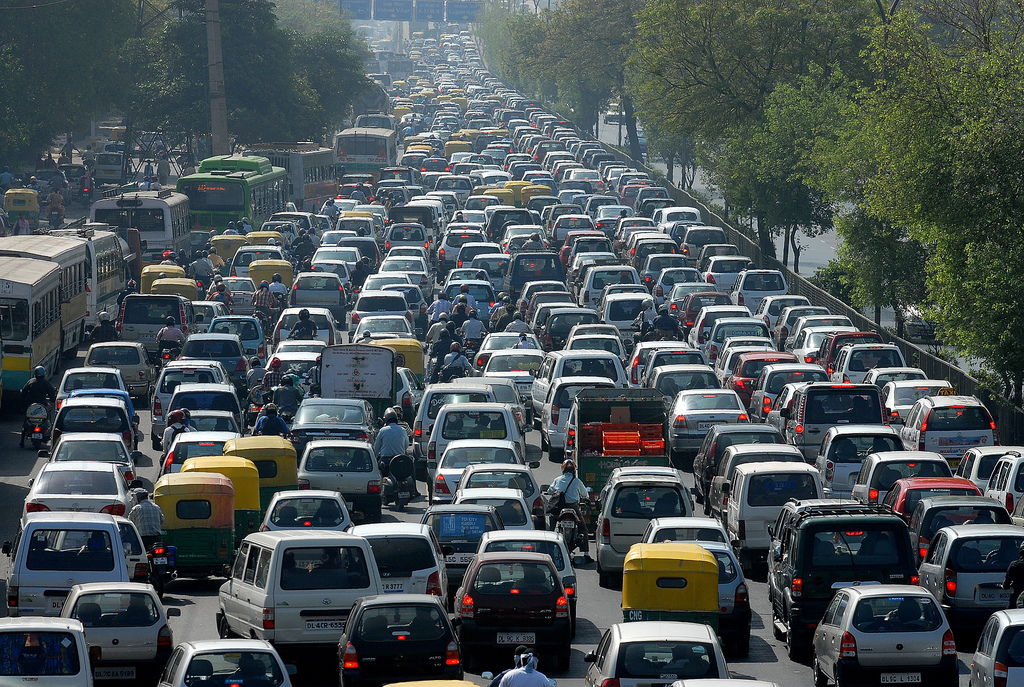
We all know the feeling: you've had a long day of work, your family's waiting for you with dinner, you're excited to go home... when suddenly you're stuck in a traffic jam and can't move an inch for 30 minutes. How do traffic jams start, and how can you avoid them? This article will help you answer these questions.
- How do traffic jams start?
- Bottlenecks (40% of all traffic): where the roadway narrows or heavy traffic demands lead to backups.
- On-road incidents (25%): crashes, stalled vehicles, on-road debris blocking the road
- Weather (15%): hail, wind, snow, fog
- Construction (10%): road construction and highway maintenance
- Miscellaneous (10%): special events (sports competitions, concerts) and poor signal timing (and poorly timed traffic lights)
- How can you avoid traffic jams?
- Most traffic jams are recurring (happens every day). Know which highways tend to be congested during the times of getting to and from work (rush-hour).
- Utilize real-time traffic displays when they are available. Lighted billboards located alongside highways can alert drivers of potential delays and advise alternate routes.
- If more people carpool, fewer vehicles would be on the road and reduce overall congestion; furthermore, cars with 3+ people can use the carpool lane, which leads to shorter commute times and fewer hassles.
Picture courtesy: http://s1.cdn.autoevolution.com/images/news/how-to-avoid-traffic-jams-35319_2.jpg
Tuesday, February 11, 2014
What to do if you get into a car accident
We understand that getting into a car accident can be frightening and stressful, but the last thing you should do is panic; there is a series of steps you should take to ensure that both you and the other party leave the scene in good graces. How you react can help prevent future injuries, reduce costs, and accelerate the clean-up/repair process.
- Safety always come first; make sure all injuries, no matter how minor, are taken care of. Call 911 for an ambulance if necessary. If it is a minor accident with no injuries, move both cars to the side of the road and out of the way of oncoming traffic. If your car is stuck and cannot move without the aid of a tow truck, turn on your hazard lights, exit the vehicle, and move to the side of the road. Ideally, you'll have flares or warning lights in your emergency kit in order to warn other cars.
- Stay calm and civil. Know that an accident is just that - an accident. No one (not you, or the other driver) is at fault; don't even say "I'm sorry," because that too can be interpreted as an admission of fault and be used against you during the insurance claim or police report.
- Exchange information with the other party. This includes name, phone number, local address, email, insurance company, policy number, drivers license number, and car license plate number, as well as the year, make, model, and color of each car involved. Never exchange your Social Security number.
- Photograph and document the accident. Use your camera to take pictures of any damage to either car; you want these photographs to demonstrate the entire context of the situation to file a claim, so be sure to take pictures from both close-up and afar. If there are witnesses, get their contact information as well, in case the other driver tries to dispute the situation. Have a written description of the time, location, road conditions, and process of the accident, including a diagram if possible.
- Call your insurance company. Report the accident as soon as possible. This ensures that the company has your side of the story on file before the other driver files a claim, which puts you at an advantage.
Image credit: http://t1.gstatic.com/images?q=tbn:ANd9GcS343yTgTKaW81Yl1OoTukiYGtbwhMTLp4TZMMQwwvBsJqag5_2
Tuesday, February 4, 2014
Car Ride Games - Part 3
We
continue our list of car ride games this week with four more ideas for passing
the time while on those long road trips this season.
1.) License Plates (#2)
– There are many versions and variations
of license plate games depending on the difficulty and age group of
those playing. 1St: Participants call out letters in alphabetical
order; the first one to Z gets a point. The player with the most points by the
end of the day/trip wins. For a greater challenge look for double or triple
letters.
Variation: Use the letters in the plate to create
a word. For example the letters CBE can spell celebrate. Where the first letter
is the starting letter of the word, the last letter is the last letter, and the
middle letter is any letter in between the final word.
2.) 20 questions – One
Person acts as a judge and chooses one random object, it can be anything. Go
around the car asking the judge yes or no questions about their object. The
first question is always “Is it an Animal, Vegetable, Mineral, or Other?” If
the guessers fail to guess the judge's object in 20 questions they all get one
last guess. If the object is still not guessed then it is revealed and a new
judge is selected for the next round.
3.) Find the Alphabet –
Utilize any reading material outside of your side of the car to call out the
letters of the alphabet in order. Roadsigns, store names, logos on trucks, ect.
should all be utilized. This game can be played in teams or as solo players.
4.) Billboard Haikus –
Each round one player chooses three random words from three different
billboards. Once all three words have been chosen the other players have one
minute to create a haiku. That is, a
three lined poem with 5 syllables in the first line, seven in the second, and
five in the third line.
5.) Road Trip Bingo –
This game is played much like a combination of Bingo and I Spy. Create a list of objects (street signs, fire
hydrants, traffic lights, garbage cans, ect.) and randomly assign them to
different boxes on multiple cards. Hand the cards out to all the participants.
Whenever someone sees the listed object on their card they can cross if out.
First player to cross out an entire row calls out BINGO! and wins.
Tuesday, January 14, 2014
Car Ride Games - Part 2
While
summer time is the season of family vacation and long rides, the winter
holidays are another popular travel time. Provided below are a list of some
popular road trip games to help pass the time.
1.) Going on a Picnic –
The first player begins by saying “I'm going on a picnic and I am bringing
(anything that begins with the letter A. Apples for example)” Players then take
turns repeating what the previous player is bringing to the picnic but then
adding an item to the list beginning with the next letter of the alphabet. For
example the 4th player of the game might say “I am going on a picnic
and I am bringing (A)pples, (B)ananas, (C)ats, and (D)odgeballs.”
ALTERNATIVE RULE: Instead of going on a
picnic players can choose to describe an object. This game varies in that
players can use adjectives instead of nouns. For a further challenge rather
than repeating the list from A-Z, begin your turn on the next letter, (F for
example) and repeat the list backwards,. For example if you were describing
your dog the game might sound like this, “My dog is a (F)rosty, (E)normous,
(D)eath-Defying.......(A)dorable person”
2.) Speak In Song – Carry on a conversation using
only the titles or lyrics from songs.
3.) 50 States – A game
for those geographical enthusiasts. List the numbers 1-50 on a piece of paper. Then try to name all 50 states. To make
things more interesting try to compete in groups of teams.
ALTERNATIVE RULE:If
this is not enough of a challenge try another round of naming all 50 state
capitols.
4.) Listen and Draw –
Supply each passenger with a piece of paper and writing utensil. Choose one
person to be the “judge” for the round. The round beings by the judge drawing a
quick picture on their own piece of paper, without showing anyone. Once the judge
is finished they then proceed to describe their image to the other players.
Once this is done, the player who's image most closely resembles the image of
the judge wins and becomes the judge of the next round.
Thursday, January 9, 2014
Buying Certified Pre-Owned Cars
A certified pre-owned car (CPO) is a car that has either been traded in or bought for resale. Automakers have dealers inspect and repair trade-ins prior to resale out of their own pocket, and then offer a warranty on the certified pre-owned cars.
Pros
- Avoids high depreciation costs
- Car has already been inspected/fixed and comes with a warranty, giving you peace of mind
- CPO programs create vehicles with higher resale values, providing increased bargaining power when it's time to trade the car in.
- Reduced-rate financing options are often available for CPO purchasers
- Just because the car is certified does not mean that it comes trouble-free. You should still have a mechanic inspect the car and take it back to the dealer for repair if any problems are found.
- Though you avoid new-car depreciation, you still have the traditional higher mileage and used-car damage that new-car buyers don't need to worry about.
- Vehicle has been inspected, repaired, and backed by a factory warranty at no cost to you
- Sends representatives periodically to ensure inspection and repairs have been made.
- Auto manufacturers tack on anywhere from 2-8% of the original used-car price for the certification sticker. Typically, the higher-end the model or brand, the higher the percentage.
- Offer extended warranties at a cost; often require deductible payments and exclusions for any "normal wear and tear" repairs and owner abuse.
- Warranty may require you to to always return to the same dealer for service or repairs
- Whether you decide to go with a factory- or dealer-backed program, always be sure to thoroughly read the warranty agreement, including the fine print and age/mileage limits.
- Know the details of the return policy, from time frame to what refunds are covered.
- Ask to see the certification checklist to make sure all major components have been inspected. Be sure to look at the vehicle repair/maintenance history as well.
- Take the CPO for a thorough test drive.
- Always negotiate - you can still haggle the price down for any CPO.
Picture courtesy: http://blogs.cars.com/.a/6a00d83451b3c669e2017616815460970c-800wi
Tuesday, December 31, 2013
Car Ride Games - Part 1
Long
rides in the car can vary within a large spectrum of entertaining and exciting to painfully dull.
The accompanying passengers, final destination, and length of the journey can
all play a factor in quality of the ride. Provided below are a list of some
popular road trip games to help pass the time.
1.) Color Hunt – At the
beginning of the trip each player chooses an uncommon type of color ( pink,
yellow, orange, purple, ect.). To avoid
confusion try to avoid some of the odd or ambiguous colors such as scarlet or
lavender. Throughout the trip players keep track of how many cars they see
painted the color they have chosen and receive a point for each one.
ALTERNATE RULES 1: Players can steal
points from one another if they spot and call a car of another passengers
color.
ALTERNATE RULES 2: One person chooses a color. The other
passengers continuously count out loud each time they see a car (or object) of
that color. Whomever counts the 10th / 20th / or any
other predetermined number wins!
2.) Secret License Plate
Message - Pretend each license plate
contains a secret message and try to decipher it. For example “ETE 830” could stand for “Elephant Tamer
Enthusiast 8 days a week 30 hours a day.”
3.) Fortunately, Unfortunately: One passenger shares
a statement beginning with the word, “fortunately.” Another passenger then
follows the statement with the word “Unfortunately.” For example one passenger
might start by saying “Fortunately, I packed everyone lunch before we left.”
and another might follow up with “Unfortunately, a bear broke into the house
and ate all of it.” Have fun with the phrases and try making up some absurd
combinations.
4.) Buzz Word – At the
start of the trip determine a word or a mixture of words that will be forbidden
for the remainder of the trip. (Choose common words such as “Mom” or “Dad”, the
more common the word the more difficult and entertaining the game becomes.)
ADDITIONAL RULE: Hand out 10 paper
clips or other markers to each player. Whenever someone says a Buzz Word, the
first player to exclaims “BUZZ!” gets to
take a paperclip (or marker) from the offender.
That's all for now. Check in later when
we continue our list of automotive entertainment.
Tuesday, December 24, 2013
What to do when your car fails an emission test
So, you failed an emission test. You can no longer register your vehicle or receive your emissions compliance sticker until the test is passed...Or can you?
First let's see what happens next for most people. That is, figuring out the one or many problem reasons why the car did not pass and have them repaired. Then, return to the emissions test facility and hope you pass the second time. However, locating and repairing the problems within your car does not always go so smoothly; leaving you to bounce back and forth between test station and repair facility, spending lots of time and money.
So how can you save yourself from potential endless loop of repairs and test? How about with a loophole in the system. For states that require periodic emissions tests, you cannot drive your car unless it has passed the test or has met “waiver” requirements.
This waiver allows some vehicles to pass an emissions test even though they have not fully met all the applicable emissions requirements. However, the waiver is not exactly fair to all those who do take the proper steps to pass the test.
Waivers were created to help drivers who can afford to bounce back and forth between test station and repair shop and pay for all the repairs required to pass. Waivers give credit to those who apply and spend a designated fixed dollar amount on repairs, thus resulting in an automatic pass.
Fixed dollar waiver amounts vary from state to state and my model year of the vehicle. Limits can vary between as little as $75 to as much as $450. It is best to ask the testing facility to confirm the correct waiver amount.
Improving Your Odds of Passing
In an effort to save yourself the time and money associated with failing the emissions test, it is in your best interest to improve odds of passing it in the first place. There are several easy steps you can take prior to increase your odds. The first is step is to maintain a clean vehicle. Keeping all aspects of your vehicle clean, especially your engine, is the is a great step towards passing the emissions test. Changing spark plugs, air filters, fuel filters, PCV valves and oil regularly or just before the test can help you pass. Additionally, filling your tank with premium gasoline can help boost octane and help lower emissions. Finally, make sure your vehicle is at normal operating temperature before you take the test. Heating the car up will heat up the oxygen sensor and catalytic converter to minimize emissions.
Tuesday, December 17, 2013
Tips for Saving Fuel

- Check your air filter. A clean air filter can improve gas mileage by as much as 10%, while dirty air filter restricts the flow of air into the engine, which harms performance and economy. Air filters are easy to check and change; remove the filter and hold it up to the sun. If you can't see light coming through it, you need a new one.
- Keeping your tires inflated properly and your engine running right is critical to efficient motoring. Make sure your tires are well aligned, since poor alignment not only causes tires to wear out more quickly, but also forces your engine to work harder. Be sure to pump up your tires, since deflated tires have more rolling resistance, which means you need to burn more gas to keep your car moving.. A properly maintained engine with emission control systems can improve mileage by up to 4%, so be sure to tune up your engine periodically.
- Make sure your gas cap isn't broken or missing. Escaping fumes not only hurt fuel economy, but release smog-causing compounds into the air.
- Drive more slowly and smoothly; avoid jack-rabbit start/stops, full-throttle acceleration, and jerky driving. Riding with your foot on the brake pedal will not only wear out brake pads (which will cost you at the maintenance shop), but can also increase gas consumption by as much as 35%. Most vehicles are most efficient when cruising in their top gear at a relatively low speed due to wind resistance. However, do not idle your car, as it both wastes gas and causes pollution.
- Lighten up the load on your car and try not to drive with too much luggage or people; for every 100 extra pounds carried around, your vehicle loses 1 to 2% in fuel efficiency.
- Shut off the air conditioner and use open windows instead at lower speeds. At higher speeds (such as on the highway), the A/C may be more efficient due to wind resistance.
Picture courtesy: http://www.thedailygreen.com/cm/thedailygreen/images/PV/car-save-gas-lg.jpg
Subscribe to:
Posts (Atom)